Australia
January 4, 2011
Recently released data from a 2009 paddock trial in Ballidu, Western Australia, has highlighted the importance of selecting the right crop type and variety to maximise yields on salt-affected land.
Funded by the Grains Research and Development Corporation (GRDC), led by the Department of Agriculture and Food (DAFWA) and supported by growers from Ballidu and Cadoux, the trial revealed a huge variation in yields from wheat and barley varieties.
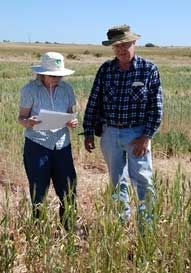 Project leader Tim Setter, of DAFWA (photo, right, with CSIRO researcher Rana Munns), said barley yields outperformed wheat yields by on average 50 per cent, and up to 100 per cent in some cases.
“The best wheat varieties were only as good as the worst barley varieties,” he said.
“This surprised me; while barley is known to yield better in saline soils, I had expected some of the wheats would be just as good as the best yielding barley varieties.”
Dr Setter said there were also up to two-fold differences in yields within both wheat and barley.
Australian breeding companies, pre-breeding groups and individuals contributed 120 wheat and 56 barley varieties, including commercial varieties and breeding lines, to be screened at the saline, alkaline (7.5 to 9.5pH) site.
Dr Setter said it was the first time so many cereal varieties and lines had been tested in an Australian field trial for their performance in saline conditions, alongside the same varieties grown in non-saline conditions.
“The data from the trial will lead to new strategies that cereal breeders and pre-breeders can use to produce better yielding varieties,” he said.
“The trial showed there is a great capacity to improve production on salt-affected soils simply by knowing the production potential of particular varieties on this type of land.”
Dr Setter said the top three traits identified for high wheat and barley yields on saline soils were early flowering/maturity; boron tolerance; and salinity tolerance at the germination and establishment stage.
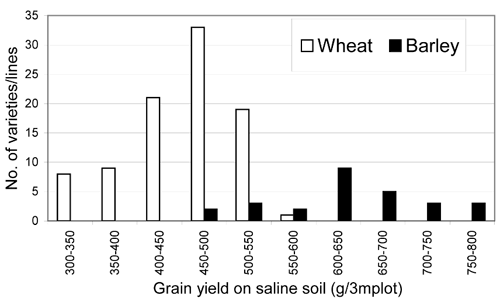
Grain yields of 130 wheat and barley varieties and lines grown on the saline site at Ballidu, WA, in 2009. The graph shows the significantly higher yields of barley compared with wheat, and a two-fold diversity of yields for both wheat and barley varieties.
“Trial results suggest that wheat could produce 25 per cent higher yields simply by reducing the days to flowering by five days, and increasing boron tolerance from 5 to 20 per cent,” he said.
“Similar results could be achieved for barley.”
Dr Setter believed earlier flowering and maturing cereals performed better in the trial because soil salinity was higher at the end of the season, and low in the middle of the season.
Salinity was equivalent to 100 to 150 per cent seawater at the start and end of the season and lower in the middle of the season at 20 to 50 per cent seawater.
Soil salinity measurements were supported by new techniques used by researchers from The University of Western Australia (UWA).
This ‘transient’ salinity – typical of salt-affected sites in WA’s grainbelt – was due to more rain being received in winter.
“Barley is much earlier flowering than wheat and I believe this is partly why it produced yields on average 50 per cent higher than wheat in the Ballidu trial,” Dr Setter said.
He said WA’s saline soils were often associated with boron toxicity.
“In five farms in the Ballidu-Cadoux area surveyed in collaboration with Curtin University (Muresk), all properties that had saline soils had boron toxicity problems,” he said.
“Boron toxicity is also common throughout South Australia and Victoria.
“There are huge opportunities to increase cereal yields simply by improving boron tolerance, and it is much easier for breeding companies to increase boron tolerance than salt tolerance.”
Dr Setter said that while the trial produced very promising results, he stressed it was only one year’s results from one location.
“This work highlights the importance of validating these results at other sites and in other seasons,” he said.
“For example, saline, acid soils at Katanning affected by aluminium toxicity may produce very different results.”
WA has the biggest proportion of salt-affected agricultural land in Australia, and a further 2.2 to 4.8 million hectares of the State’s agricultural land is expected to develop salinity.
For more information about the trial, contact Tim Setter on tsetter@wa.agric.gov.au


 Species