Malawi
24 September 2019
Without a doubt, maize is the giant of all food crops in Malawi. However, most smallholder farmers often intercrop maize with soybean, making it an equally important crop. Soybean enhances soil fertility by fixing nitrogen in the soil which results in improved crop yields thus better incomes.
Between 2013-2017, farmers in Malawi on average harvested 0.98 t/ha of soybean which is below the African average of 1.24 t/ha and global average of 2.68 t /ha (2017 FAO). To improve production, national and international researchers have bred and released new soybean varieties. In the last 19 years, over 15 improved varieties have been released.
In spite the release of improved varieties and new management practices no one knew whether farmers were adopting them or not. Scientists, led by IITA’s Dr. Adane Hirpa Tufa, conducted a study to find out if these new varieties and management practices were being adopted, and if so, what changes were farmers experiencing.
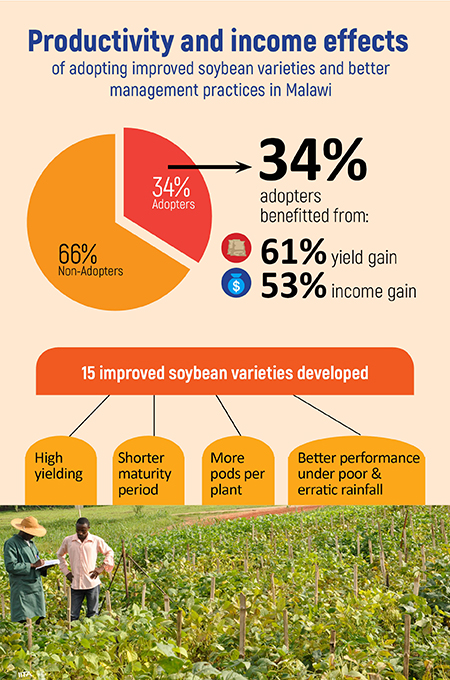
“We studied 1,237 farmers on 1,465 plots and found that over a third of sampled farmers adopted the new varieties and practices which resulted in 61% yield gain and 53% income gain,” Tufa said. The study results which have been published in a peer-reviewed journal article titled “The productivity and income effects of adoption of improved soybean varieties and agronomic practices in Malawi” show that adopters are younger, more educated, and have larger cultivated land. Adopters also tend to be members of a farmers’ organization, participate in seed markets and have access to extension services. This implies that adoption is greatly influenced by access to information.
Although it is now proven that adoption of improved seed varieties and agronomic practices can improve farmers’ incomes, it is unfortunate that very few have access to this information. Tufa called for more awareness saying, “with only 34% of the sampled farmers being adopters, more awareness is needed if more farmers are to benefit from improved technologies.”
These new varieties are high yielding, have a shorter maturity period, more pods per plant and perform better under poor and erratic rainfall. Better agronomic practices such as the right planting dates, close row spacing that can smother weeds, and correct and timely application of phosphorus fertilizers have also been popularized through projects such as “Putting Nitrogen Fixation to Work for Smallholder Farmers in Africa (N2Africa)” and “Malawi Improved Seed system and Technology (MIST)”. Those projects were led by IITA, Government of Malawi, NGOs and community-based enterprises.


 Topics
 Species