Ithaca, New York, USA
January 5, 2022
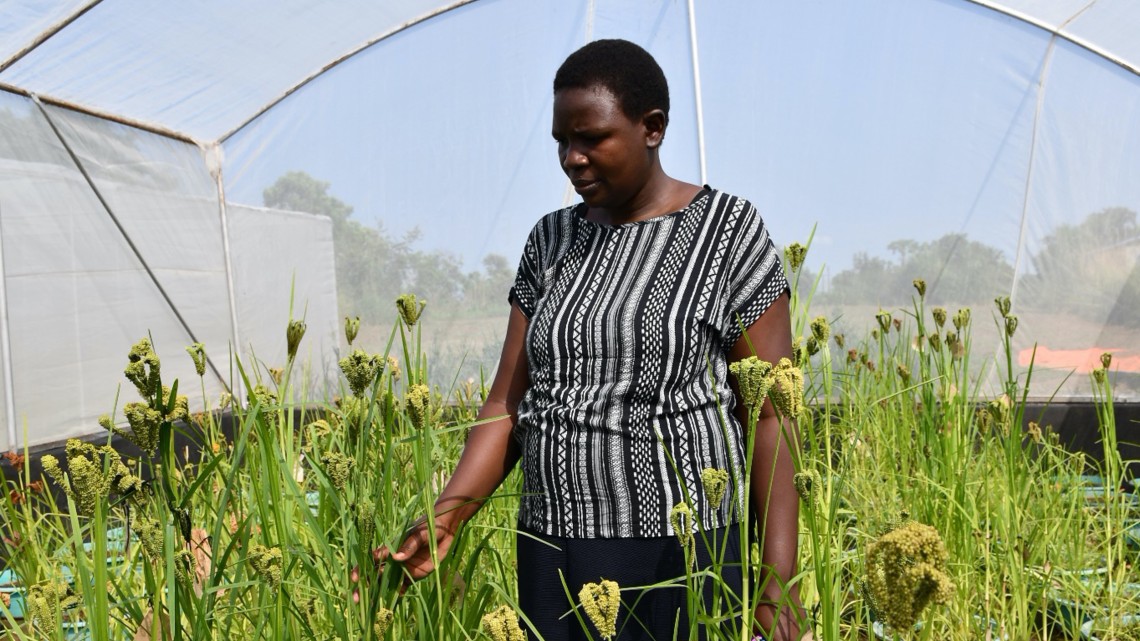 Scovia Adikini, principal investigator of the East African Center of Innovation for Finger Millet and Sorghum, reviews crosses of finger millet in a screen house in Uganda. - Credit: National Semi Arid Resources Research Institute (NaSARRI)
Sorghum growers across Africa’s dry-land regions face a common, relentless foe — striga. This parasitic plant attacks the root of millets like sorghum, devastating the plant’s yield and endangering food security for rural communities which depend on sorghum as a major source of carbohydrates and micronutrients.
Plant breeders across Africa are on a mission to defend farmers against striga infestations. To start, they must be able to measure the growth, performance and composition of sorghum and striga, which historically has been difficult due to access to and investment in technology. Now, accessible digital tools are being deployed in innovative ways by the Center of Innovation for Finger Millet and Sorghum (CIFMS), which is helping scientists react swiftly to breed improved varieties.
CIFMS launched in 2021 as part of the Feed the Future Innovation Lab for Crop Improvement housed in the College of Agriculture and Life Sciences’ Department of Global Development.
With support from ILCI’s breeding informatics and phenomics teams, CIFMS is updating and adapting existing technologies for digital data collection in the field. Together, the teams developed an approach to collect and analyze striga seed samples within the Field Book app, a single digital platform that simplifies field data collection while reducing transcription errors. Breeders are working directly with smallholder farmers to simultaneously collect seeds and capture farmers’ knowledge about the striga affecting their fields, according to Scovia Adikini, principal investigator of CIFMS based at the National Semi Arid Resources Research Institute (NaSARRI) in Uganda.
Read more at the Innovation Lab for Crop Improvement website.
This article was written by Robinah Nakabaggwe, a communications associate at NaSARRI, and edited by Kelly Merchan, communications specialist at Cornell Global Development.


 Topics
 Species