Manhattan, Kansas, USA
June 23, 2025
K-State has joined a multi-state effort to develop diagnostic tools for herbicide-resistant weeds in soybeans, a project that will cover most of the soybean-growing regions of the United States.
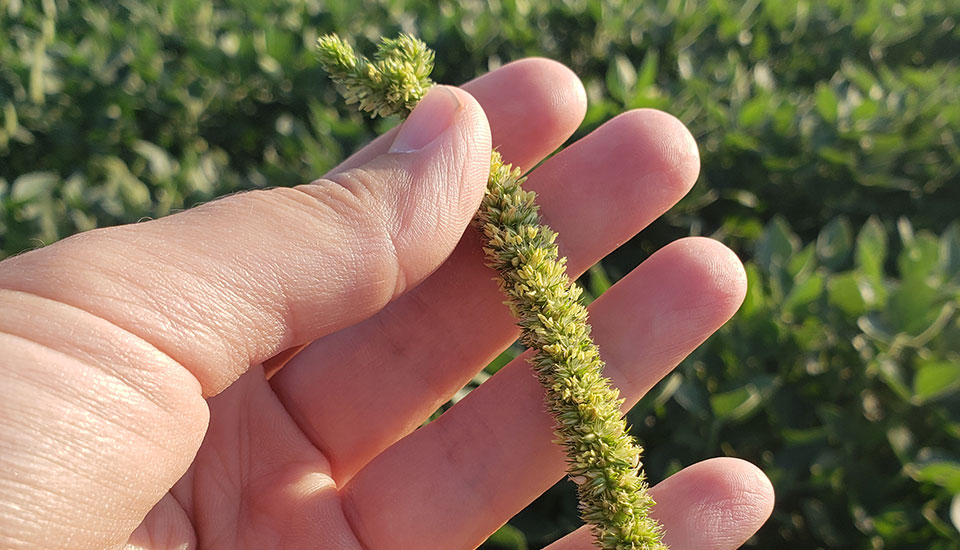
K-State has joined a multi-state project aimed at developing diagnostic tools for herbicide-resistant weeds, such as Palmer amaranth.
Kansas State University has joined a multi-state effort to develop diagnostic tools for herbicide-resistant weeds in soybeans, a project that will cover most of the soybean-growing regions of the United States.
K-State weed specialist Sarah Lancaster said that for decades, the primary method of eradicating weeds in soybean fields has been chemical control, or herbicides. But over the years, many weed species have developed increased levels of resistance to those chemicals.
Michigan State University leads the $500,000 project, funded by the United Soybean Board. In addition to K-State, partner universities include Mississippi State, Penn State, Purdue, Texas A&M, Arkansas, Illinois, Missouri and Wisconsin.
“Long term, this project has the potential to vastly increase the understanding of herbicide resistance at the molecular level, the plant level, the field level, and across the region,” Lancaster said. “I think these initial steps of developing screening and communication tools can potentially lead to a paradigm shift in how we understand and communicate the science of herbicide resistance.”
According to a 2014 study supported by the United Soybean Board, herbicide resistant weeds cost U.S. soybean growers more than $2 billion annually. Since then, populations of these weeds have proliferated across the country and now affect almost every major U.S. crop – which means the financial impact on U.S. agriculture is even larger.
Eric Patterson, an assistant professor and weed geneticist at Michigan State, said the new project is broadly aimed at developing rapid diagnostic tools to detect resistance in weeds, increasing the screening capacity and improving management recommendations.
The work is rooted in extension, with an over-arching goal to deliver effective strategies directly to soybean growers. Lancaster said outreach is the primary focus of the K-State team.
“First, we’ll be creating a series of short videos about herbicide resistance,” she said, noting that topics include metabolic herbicide resistance, herbicide resistance management tactics and information about weed species in which resistance is often found.
“Secondly, we are working to develop a county-level map of confirmed cases of herbicide resistant weeds,” Lancaster said. “This information will be very helpful for farmers and their advisors as they develop herbicide programs.”
The work will increase direct interactions between academic weed scientists, farmers and their advisors.
“We understand that herbicide resistance management is necessary in all fields, but the map we’re developing will help farmers adjust their practices to account for herbicides that are less effective due to resistance,” Lancaster said.
Other project objectives, according to Lancaster, include:
- Streamlining a process to share information about weed resistance between U.S. universities.
- Developing rapid assays to determine the resistance status of weed populations in days, rather than weeks or months.
- Better understanding resistance for pre- and post-emergent herbicides, and differences between timing of applications.
“Our (K-State) team is ramping up our efforts in screening populations for resistance via this funding, as well as funding from other commodity groups,” Lancaster said. “We will be collecting samples this fall and would be happy to consider collecting samples for anyone who has a concerning population. We are particularly interested in Palmer amaranth and waterhemp.”
Related: 2025 Chemical Weed Control (publication) | Kansas Soybean Management (2025)


 Topics
 Species