June 27, 2025
Enhancing efforts in developing agricultural technologies is key to revolutionizing the agriculture sector. Such innovations can significantly reduce losses caused by plant diseases and empower smallholder farmers to make informed decisions throughout the production process.
Prof. Amal El-Ghazaly from Cornell University delivered a powerful seminar and valuable insights to the IITA–CGIAR breeders and scientists on “Sensing underground crops to understand the interdependence of food, agriculture, and climate.” She introduced ground penetrating radar (GPR), an innovative technology for monitoring underground crop growth at all stages. This technology will help boost Cassava productivity and ensure food security.
While introducing this technology to participants, she noted, “I am sure you all wonder how exactly you see what is in the ground. How do you monitor a crop that is growing underneath the soil surface? And ideally, can we do that without destroying or uprooting the crop? There are many ways to detect properties in the soil, and they are used in different contexts based on their environment. But what we use is what is called ground-penetrating radar (GPR).
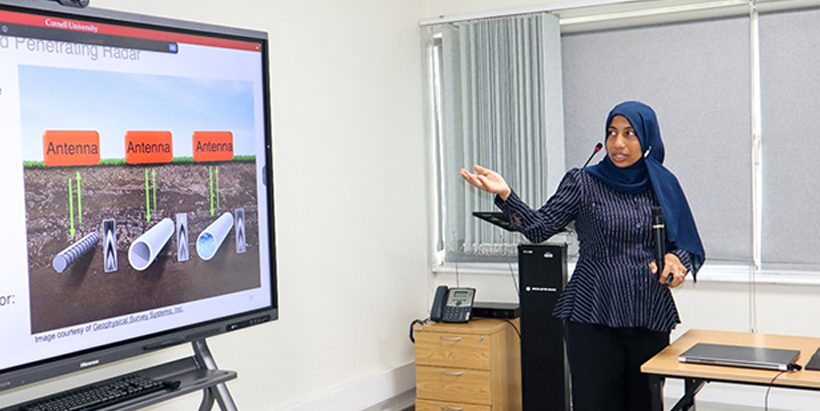 Prof. Amal El-Ghazaly explaining the importance of GPR technology to participants. (Photo: Rashid Hadi/IITA)
Moreover, Prof. El-Ghazaly has been working closely with the Cassava breeding program, and this crop was used as a test. She engaged with the IITA cassava breeding team to collect data in the field and showed its importance in enhancing food, agriculture, and nutrition security. More efforts are also invested in understanding the development of technologies to help bananas, tubers, and roots since this technology can be used for many crops.
Prof. El-Ghazaly, expressing his interest in choosing cassava over other crops, noted, “Cassava is a staple household crop, and every part of the plant is utilized. The leaves are commonly used as a food ingredient and can also serve as animal feed. The stems are used for replanting to grow new cassava plants. Cassava roots can be boiled or fried — we had it for breakfast on my first day here. Additionally, cassava starch is used in producing beverages, as a sweetener, and even for making alcohol.”
Staff from IITA expressed their strong interest in technology and emphasized the importance of creating a scalable environment to extend its reach to a greater number of smallholder farmers. This includes raising awareness among agricultural stakeholders such as extension officers, farmers, and partners to ensure the effective dissemination and adoption of technology.
“There is a need to use this technology in terms of sustainability. Hence, we can link our technologies for cassava, such as AKILIMO and Plant Village Nuru, into one platform to ensure many smallholder farmers benefit from these technologies,” Mwantumu Omari, IITA Scaling Specialist, noted.


 Topics
 Species