Cold Spring Harbor, New York, USA
July 9, 2025
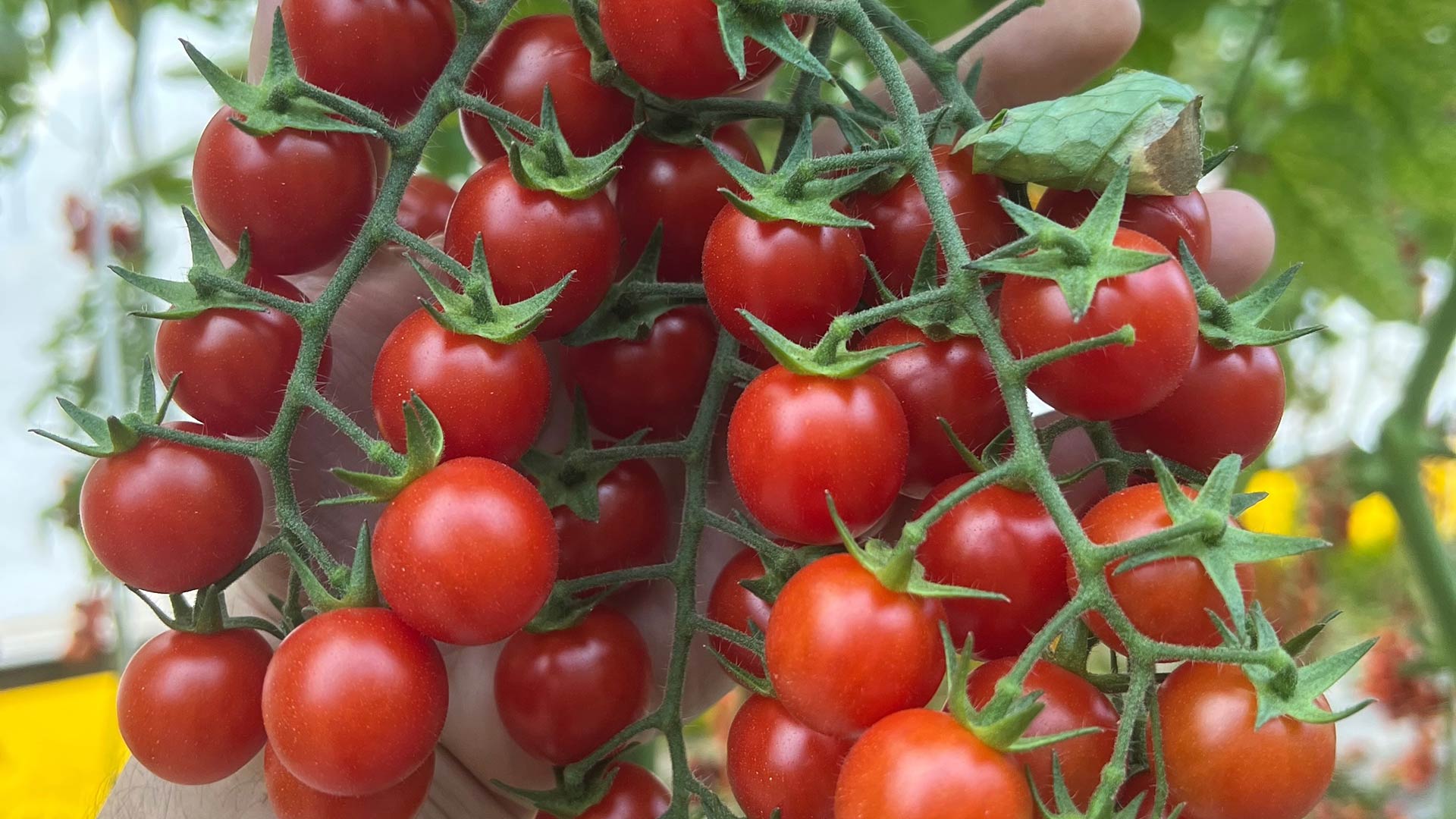 Tomatoes grow on the vine at Uplands Farm, about a mile east of Cold Spring Harbor Laboratory’s main campus on Long Island. The agricultural research station offers a shared resource for CSHL scientists studying various topics, from plant genetics to quantitative biology and cancer.
Picture juicy red tomatoes on the vine. What do you see? Some tomato varieties have straight vines. Others are branched. The question is why. New research from Cold Spring Harbor Laboratory (CSHL) provides the strongest evidence to date that the answer lies in what are called cryptic mutations. The findings have implications for agriculture and medicine, as they could help scientists fine-tune plant breeding techniques and clinical therapeutics.
Cryptic mutations are differences in DNA that don’t affect physical traits unless certain other genetic changes occur at the same time. CSHL Professor & HHMI Investigator Zachary Lippman has been researching cryptic mutations’ effects on plant traits alongside CSHL Associate Professor David McCandlish and Weizmann Institute Professor Yuval Eshed. Their latest study, published in Nature, reveals how interactions between cryptic mutations can increase or decrease the number of reproductive branches on tomato plants. Such changes result in more or fewer fruits, seeds, and flowers. The interactions in question involve genes known as paralogs.
“Paralogs emerge across evolution through gene duplication and are major features of genetic networks,” Lippman explains. “We know paralogs can buffer against each other to prevent gene mutations from affecting traits. Here, we found that collections of natural and engineered cryptic mutations in two pairs of paralogs can impact tomato branching in myriad ways.”
 Left: CSHL Professor & HHMI Investigator Zachary Lippman. Right: CSHL Associate Professor David McCandlish.
One crucial component of the project was the pan-genome Lippman and colleagues completed for Solanum plants around the globe, including cultivated and wild tomato species. Where genomes typically encompass one species, pan-genomes capture DNA sequences and traits across many species. The pan-genome pointed Lippman’s lab toward natural cryptic mutations in key genes controlling branching. Lippman lab postdoc Sophia Zebell then engineered other cryptic mutations using CRISPR. That enabled Lippman’s lab to count the branches on more than 35,000 flower clusters with 216 combinations of gene mutations. From there, McCandlish lab postdoc Carlos Martí-Gómez used computer models to predict how interactions between specific combinations of mutations in the plants would change the number of branches.
“We can now engineer cryptic mutations in tomatoes and other crops to modify important agricultural traits, like yield,” Lippman says. Additionally, the kind of modeling done here could have many other applications. McCandlish explains:
“When making mutations or using a drug that mimics the effects of a mutation, you often see side effects. By being able to map them out, you can choose the manner of controlling your trait of interest that has the least undesirable side effects.”
In other words, this research points not only to better crops but also better medicines. So, you see tomatoes? Science sees tomorrow.
Funding
National Institutes of Health, Israel Science Foundation, Simons Center for Quantitative Biology at Cold Spring Harbor Laboratory, National Science Foundation, Plant Genome Research Program, Gatsby Charitable Foundation, Howard Hughes Medical Institute
Citation
Zebell, S.G., et al., “Cryptic variation fuels plant phenotypic change through hierarchical epistasis”, Nature, July 9, 2025. DOI: 10.1038/s41586-025-09243-0


 Topics
 Species