Fargo, North Dakota, USA
August 14, 2025
Producers can use soybean iron chlorosis scores to select soybean varieties for the 2026 season.
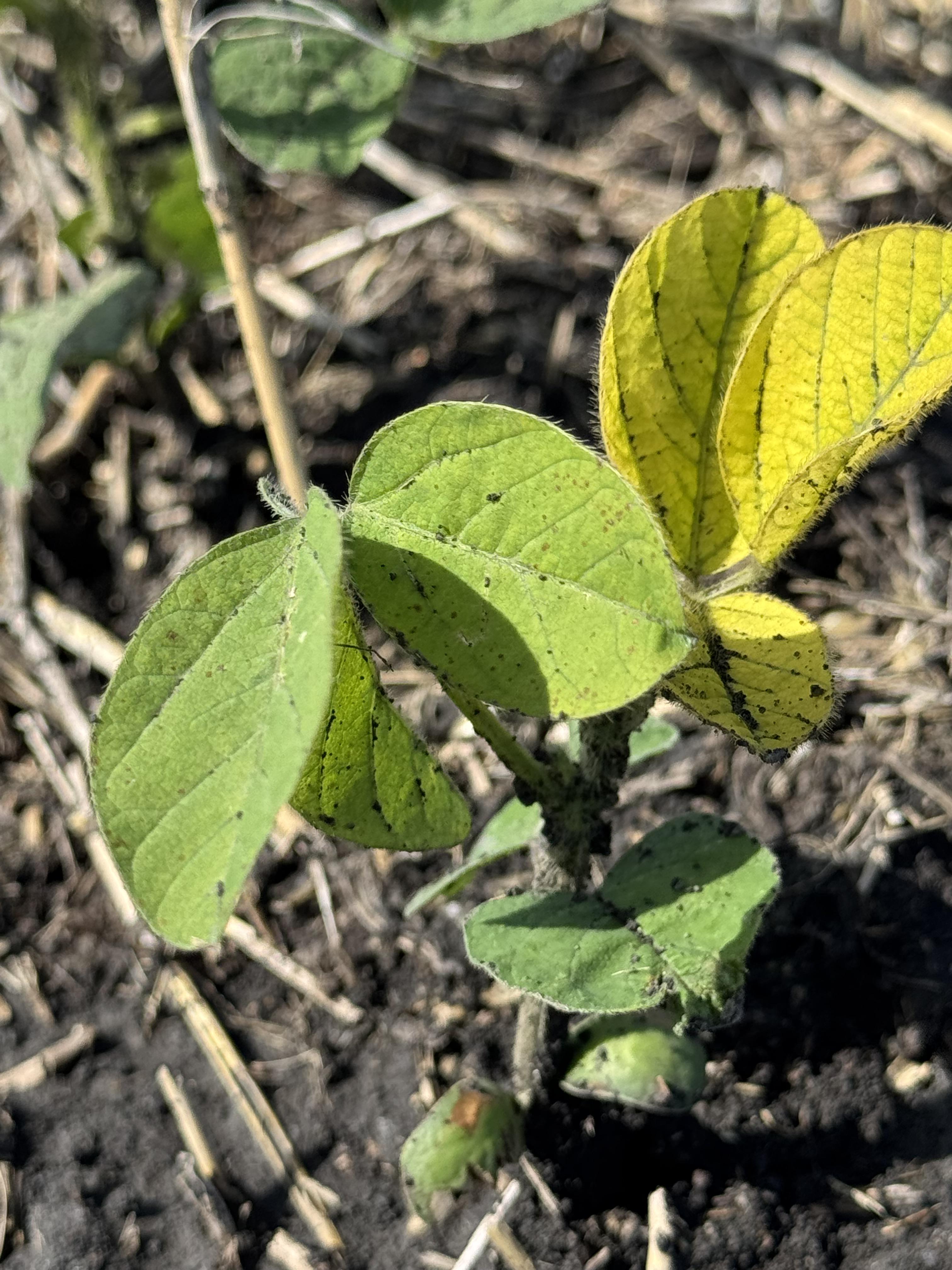 Selecting a soybean variety with IDC tolerance is an important management decision that can help producers minimize the negative impact of chlorosis on yield. (NDSU photo)
Similar to last year, cool and wet conditions caused prolonged iron deficiency chlorosis (IDC) symptoms in North Dakota soybean fields, says Ana Carcedo, North Dakota State University Extension broadleaf crops agronomist.
NDSU conducts annual research on soybean varieties to determine their tolerance to IDC. This information is crucial for farmers who deal with IDC in their fields annually. Choosing soybean varieties less susceptible to IDC is the first line of action to deal with IDC, advises Carcedo.
According to Carrie Miranda, NDSU soybean breeder, "Soybean varieties exhibit genetic differences in their tolerance to IDC symptoms. Producers can use the NDSU data to choose an appropriate IDC-tolerant soybean variety for fields known to have IDC issues in the 2026 season. Selecting a soybean variety with IDC tolerance is an important management decision that can help producers minimize the negative impact of chlorosis on yield."
In the summer of 2025, NDSU's soybean breeding program evaluated 131 Enlist, GT27, Roundup Ready, Xtend, and conventional soybean varieties for IDC tolerance.
IDC symptoms include yellowing of plant leaves with green veins, as well as yellowing, browning, and stunted growth during the early stages, leading to reduced soybean yields. The test results are based on replicated trials conducted in a location with a history of IDC. Visual ratings were made on a 1 to 5 scale, with 1 indicating no chlorosis and 5 indicating the most severe chlorosis. Ratings were recorded at three different soybean growth stages.
The test results are available at https://vt.ag.ndsu.edu/list/soy. NDSU soybean variety trial yield data will also be published at this link.
While IDC tolerance is important, producers are advised to consider the yield potential and other important traits of soybean varieties. Varieties with similar IDC tolerance can differ significantly in their yield potential.
The North Dakota Soybean Council provided funding for the iron deficiency rating studies.


 Topics
 Species