Florida, USA
October 21, 2025
By commercializing their research, two University of Florida scientists are trying to get practical AI tools into the hands of our state’s farmers. The goal is to build their business by increasing farm profitability, lowering the costs of inputs such as pesticides and labor -- and feeding more people.
They are doing that by building a new business.
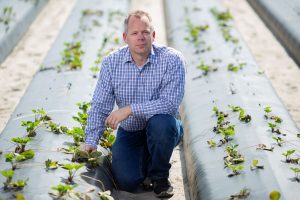
Nathan Boyd in a field at the UF/IFAS Gulf Coast Reseach and Education Center. By Tyler Jones, UF/IFAS photography.
About two years ago, Nathan Boyd joined forces with Arnold Schumann -- a frequent research collaborator -- to form EZ Ag Innovations (EZ-AI). Boyd is the president, Schumann is the company’s chief scientific officer and Martyn Ballestero is the CEO.
EZ-AI technology – which is patented and licensed by UF -- can help growers spray only weeds and minimize damage to surrounding crops, including strawberries and tomatoes.
“We are committed to sustainability and responsible stewardship of the land. Our precision-spraying techniques minimize the use of chemicals and minimizes environmental impact, while still providing optimal crop protection.” —Nathan Boyd, a professor of horticultural sciences and associate director of the UF/IFAS Gulf Coast Research and Education Center
The EZ-AI team has already started asking growers what they want, to make sure they build technology that addresses their needs. Then, they’ll demonstrate the technology on farms so growers can use it and provide clear, reliable data on the benefits, costs and return on investment.
“We are committed to working with growers and helping them be successful,” Boyd said. “We believe food security is important to national security, and we want to be part of the solution. Our targeted spray systems apply pesticides only where they are needed and will lower costs for growers.”
It’s hard work but well worth it, said Boyd, a professor of horticultural sciences and associate director of the Gulf Coast Research and Education Center, part of the UF Institute of Food and Agricultural Sciences (UF/IFAS).
“Running a startup is incredibly difficult and stressful,” Boyd said. “There are the standard steps like registering with the government, finding space, getting grants, hiring people, choosing accountants, building pitch decks and so on. There is significant research and development needed to go from a protype to a minimal viable product (the simplest version that will work) and that takes time.”
Targeted spraying means preserving the environment.
“We are committed to sustainability and responsible stewardship of the land,” Boyd said. “Our precision-spraying techniques minimize the use of chemicals and minimizes environmental impact, while still providing optimal crop protection.”
Boyd described the start-up process as “hectic and challenging to navigate but rewarding to see progress.”
“Understanding what is needed to develop technology to reach the grower helps me understand as a researcher how to focus my time,” he said. “For example, perhaps I can build a widget, but if it’s not commercialized because the customer base is too small and the costs are too high or it doesn’t address an issue for growers, then I am wasting my time and the government’s money if I spend my time on something that ultimately has no chance of being useful to the end user.”
Schumann, a professor of soil, water, and ecosystem sciences at the UF/IFAS Citrus Research and Education Center, said he went into business with Boyd because they shared goals.
Both scientists recognized commercialization as the most expedient avenue to get research-based solutions to growers to help them solve practical problems.
Schumann thanks his business collaborators.
“I would not create a startup by myself,” Schumann said. “It is a steep learning curve to navigate, and it helps me greatly that I can focus on research and development, while my co-founders manage the other essential aspects of a business.”


 Topics
 Species