Otago, New Zealand
June 2, 2026
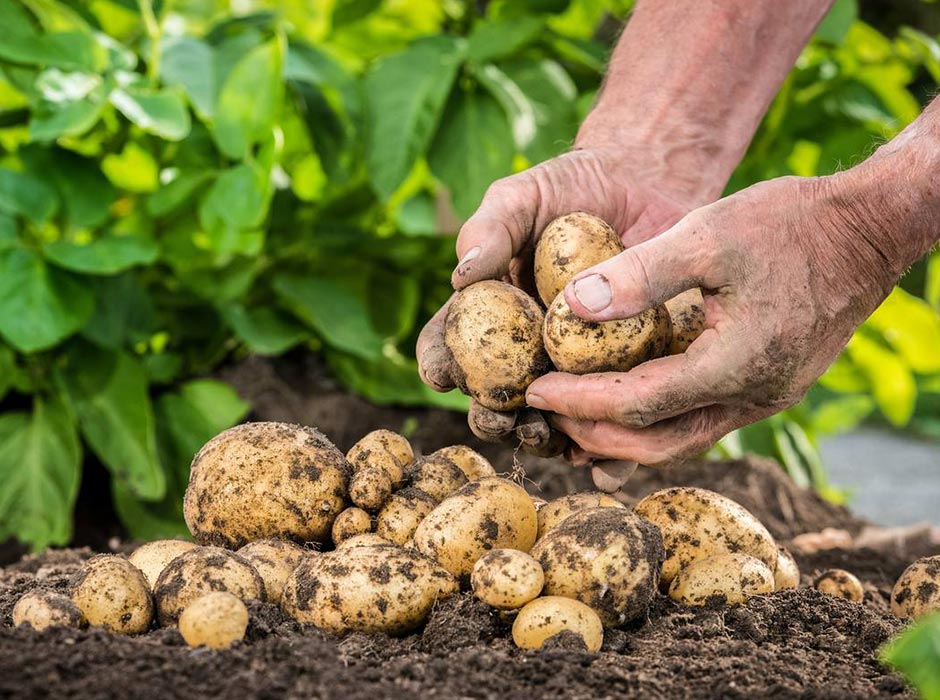 Crops like potatoes will benefit from the Combined Inbreeding and Outcrossing (CIAO) innovation, helping create stronger hybrids with beneficial traits.
What if you could grow potatoes from seeds instead of tubers?
A research team led by Biochemistry Research Fellow Rowan Herridge, Associate Professor Lynette Brownfield and Professor Richard Macknight has developed a biotech innovation to help breeders create stronger crops and improve hard-to-breed species, supporting a more sustainable future for farming.
Rowan says the new technique uses targeted genetic modification to make breeding easier, faster and more reliable – by controlling plants’ natural tendency to reject their own pollen.
“Important agricultural species such as potato, ryegrass and brassicas like cauliflower display this self-incompatibility.”
This makes it harder for breeders to fix beneficial traits – such as disease or drought resistance – and pass them down to the next generation.
“To overcome this, we devised Combined Inbreeding and Outcrossing (CIAO), a method that allows plants to self-fertilise during breeding and then leverage their natural self-incompatibility to enforce breeding with other genetic variants to make valuable hybrids – a sort of best of both worlds.”
The potential impact goes beyond the lab. In crops like potatoes, for example, the technology could shift production from bulky tubers to lightweight seeds – reducing storage and transport demands and offering a more efficient way to grow food at scale.
 Biochemistry researchers, from left Professor Richard Macknight, Associate Professor Lynette Brownfield and Research Fellow Rowan Herridge led the team behind the Combined Inbreeding and Outcrossing (CIAO) innovation.
CIAO could also be a valuable tool to help address environmental issues affecting farming and crop yield, like climate change and disease.
“By offering a flexible and efficient approach, CIAO allows breeders to more easily create varieties of plants that are higher yielding and more resilient in a rapidly changing environment,” Rowan says.
“We are also exploring possibilities with self-incompatible orphan crops – crops that have been grown historically, but not commercially – bringing such crops to commercially viable levels of productivity would be a huge achievement.”
With the support of Otago Innovation Limited (OIL), CIAO is currently being developed in collaboration with a multinational breeding company and is making its way through the patent process.
Commercialisation Manager Graham Strong says there is potential to further amplify the reach and impact of CIAO.
“We are open to partnerships that extend CIAO’s applicability in the field, exploring the possibilities of creating stronger, more viable hybrid plant varieties that can deliver tangible benefits for agriculture, industry, and food production worldwide.”
Explore the science behind CIAO:
A New Breeding Technique for F1 Hybrid Production From Self-Incompatible Species
Rowan P. Herridge, Prasanthi Namburi, Shiny Varghese, Richard C. Macknight, Lynette R. Brownfield
Plant Biotechnology Journal
From proof of concept to commercialisation
Recognising the potential of their research to transform hybrid crop breeding made commercialisation the go-to option for the CIAO team.
“We saw potential in our invention to be patentable and valuable to investors and industry,” Rowan says.
The research team’s introduction to the commercialisation process came via the annual Proof of Concept competition, organised by the University of Otago’s technology transfer office, Otago Innovation Limited (OIL).
Proof of Concept is an opportunity for academics, post-docs and PhD candidates to test the commercial application of their ideas in front of an expert panel. This year, the competition celebrates 20 years since it first began.
Graham says the Proof of Concept competition is an exciting first step for researchers to explore commercialisation as a way to create broader impact from academic research.
“It is not just the winner that benefits from the competition. Judges often see more than one idea worth investing in.”
CIAO was one such example, he says.
“CIAO didn’t win in the year it participated, but we saw that it did have potential commercial application.
“We did a detailed commercialisation assessment on the technology, identified that it had very strong commercial possibilities and then went through a process of seeking investment for it.”
The commercialisation experience with OIL was eye-opening, Rowan says.
“Working with Graham Strong at OIL has been very helpful. The depth of knowledge required to attract industry engagement, navigate intellectual property protection, and find pathways to commercialise research was really substantial.
“As well as providing our group with more commercial acumen and strengthening our connection with industry, doing research aligned with commercial outcomes increased the chances of CIAO being taken up.”
Associate Professor Lynette Brownfield says that with commercialisation as the aim for CIAO, it had a large impact on the design and management of the project.
“OIL was involved in the research from an early stage and provided support across multiple areas like funding, IP protection, and making contact with potential partners.”
Partnering with industry has given the team the opportunity to visualise CIAO in action in the field, she says.
“As university scientists, we are often driven by our desire to understand the system that we work on, but seeing the potential for that research to also make real-world impact is very exciting.”
Proof of Concept 2026
Proof of Concept 2026 offers three prizes celebrating people and projects solving real-world problems with big, bold, innovative ideas:
- $100,000 R&D investment to progress an idea toward commercial application
- $100,000 convertible note to kick start formation of a spin-out company
- $6,000 Postgraduate Student Internship opportunity to support planning, market research, customer discovery, competitor analysis, and business case development.
Applications for the Proof of Concept 2026 competition open on 2 June. Find out more about the competition, the judges and register your interest.


 Topics
 Species