United Kingdom
30 July 2026
When dry turns to drought, how can livestock farms meet forage needs? Grassland expert Harley Brown-Keech explains which drought tolerant crops can bring resilience to your grassland system when the weather turns extreme.
Diverse swards deliver more
Each plant in a multi-species mixture brings different qualities to a sward. Perennial ryegrass leads the way with strong early season growth, supported by legumes and herbs stepping up when it gets dry.
In a Germinal Horizon trial, multi-species mixtures produced around 26% more yield over four years than swards with perennial ryegrass only. When the trial faced a 16-week drought in 2022, the ryegrass stopped growing but legumes and herbs kept producing. When the rain returned, the perennial ryegrass showed resilience and responded first.
Plant diversity helpsReduce forage deficits under drought comditions, allowing livestock to access high-quality feed for longer.
What are the most effective drought tolerant forage crops?
Persistent grass species
High quality perennial ryegrass should form the base of your mixture. Despite other grass species being lower in quality than perennial ryegrass, they also play a role in the mixture, producing yield when perennial ryegrass plants enter survival mode without water.
- Timothy – a hardy, persistent, grass that performs well if you have heavy soil. Producesaround 10t DM/ha
- Cocksfoot – a deep-rooting grass that will give you an extra week of grazing into drought that perennial ryegrass won’t. Yields around 10t DM/ha.
- Fescues – of more than 300 species, you’ll find drought tolerance and high yields in Meadow fescue (10-12t DM/ha) fescue and Tall fescue (10t DM/ha).
Festuloliums
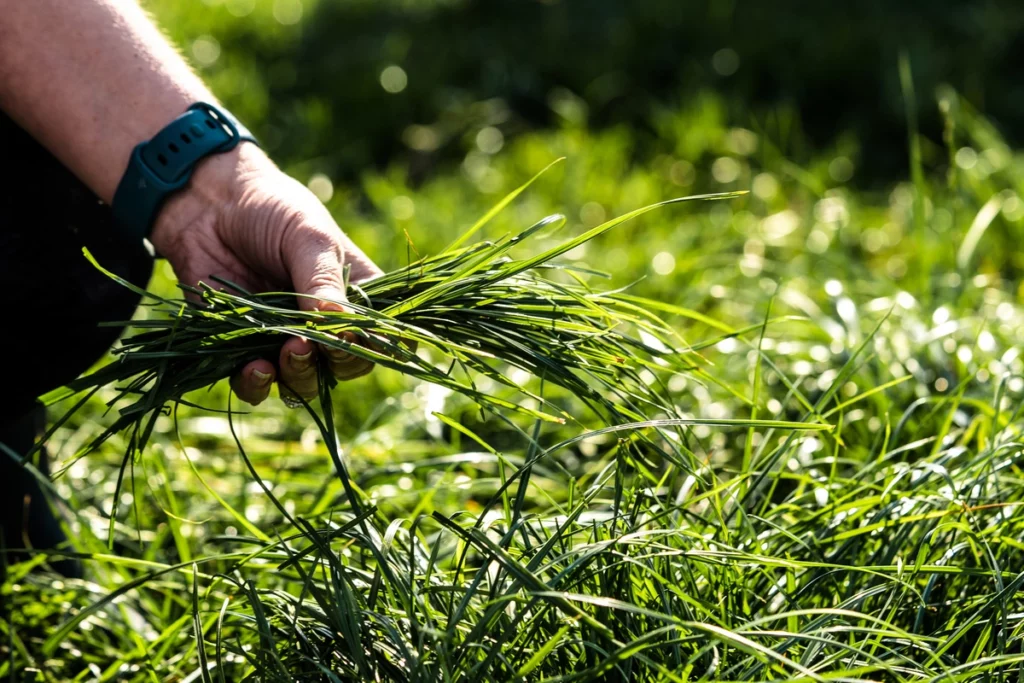
Combining fescue’s deep roots with ryegrass performance, these hybrids make your sward stress resilient and productive in dry weather:
- AberRoot – a cross of Atlas fescue and perennial ryegrass, AberRoot gives you deep-rooting growth and high-yielding, high-quality forage.
- AberNiche – fescue drought tolerance and Italian ryegrass performance gives you production that lasts up to four years.
Both varieties available in Climate Smart ADAPT, our mixture range developed to maintain forage production and reduce risk during dry spells.
Hybrid ryegrass
Italian ryegrass is tempting because it establishes in 7-10 weeks, but varieties go to head quickly and only survive for two years, making it less valuable. The best short-term option is a cross between Italian and perennial ryegrass. Germinal’s hybrid ryegrass varieties grow earlier in spring and later in autumn to extend your growing season.
Find them in short-term grazing and silage mixtures from our Climate Smart CLEAN range.
Hybrid clover
DoubleRoot. bred by Germinal Horizon delivers persistent performance through temperature extremes of up to +30°C. This world-first hybrid clover survives three weeks longer into drought than conventional clovers due to the plant’s unique dual growth habit.
Red clover
Consider Germinal’s higher-yielding, more persistent variety AberClaret with a deep taproot that improves drought resilience and maintains high DM yields for 4-5 years.

Herbs
Germinal Horizon research shows that certain herbs struggle to persist in multi-species swards, but two species are proven to last longer:
- Chicory – a deep taproot delivers high drought tolerance and around 17-18% protein content.
- Plantain – a medium ballroot and a coarse root structure helps it persist in dry weather
Trust the forage experts
To mitigate crop risk from drought, choose adaptive forage mixtures.
Talk to your regional Germinal expert to get the right mixtures for your grassland system.


 Topics
 Species