The Netherlands
August 31, 2026
A seed counter answers one question: how many seeds are in this batch? A seed dispenser answers a different one: which seed sits in which position? Labs often start shopping for a seed counter when the job in front of them is actually the second question. This article separates the two, using what recent research reports about automated counting and about the sample handling that comes after it.
What a seed counter measures
Counting equipment comes in two broad types. Mechanical and optical counters pass seeds one at a time along a track and register each one as it goes by. Image based systems photograph a whole batch at once and count what the software recognises. The second type has improved quickly.
Zu and colleagues compared classical image processing with a YOLOv5 deep learning model across fifteen species, from maize and wheat to Kentucky bluegrass and smooth pigweed. The deep learning model reached a precision of 0.963, a recall of 0.911, an F1 score of 0.936 and an mAP50 of 0.951, and processed an image in roughly 0.33 seconds (Zu Q, Liu T, Zhu W, Pan Y, Wang J, Song X, Yu J, Dang S, Yu X, Zhang Z, 2025, Frontiers in Plant Science 16, doi.org/10.3389/fpls.2025.1659781).
The same paper is clear about where the approach struggles. For the smallest seeds the deep learning method undercounted: it detected 27.33 plus or minus 0.42 of 100 smooth pigweed seeds, and 39.83 plus or minus 0.54 of 70 Kentucky bluegrass seeds (Zu et al., 2025). Counting accuracy is species dependent, and small seeds that touch or overlap are the hard case. If your work is on Arabidopsis or on grass seed, that finding matters more than the headline numbers.
Counting a batch is not the same as placing a seed
A counter returns one number for a population of seeds. Most downstream lab work needs the opposite: individual seeds in individual, addressable positions. Germination scoring, vitality testing, single seed DNA extraction and phenotyping all depend on knowing that well A1 held exactly one seed, and which seed that was. A count on its own cannot carry that information.
This is the gap a dispenser fills. A LabTIE seed dispenser holds one seed in every hole of a mesh plate, and one tap drops the whole set into the labware underneath in a single motion. Our product pages list a working range of 0.2 to 9.0 mm and more than 120 seed types, with mesh plates that swap out per species. For the 96-well seed dispenser we state about 45 seconds per plate and fewer than 1 percent empty wells. Those are our own figures from our own pages, not a published measurement, and we say so rather than dressing them up as research.
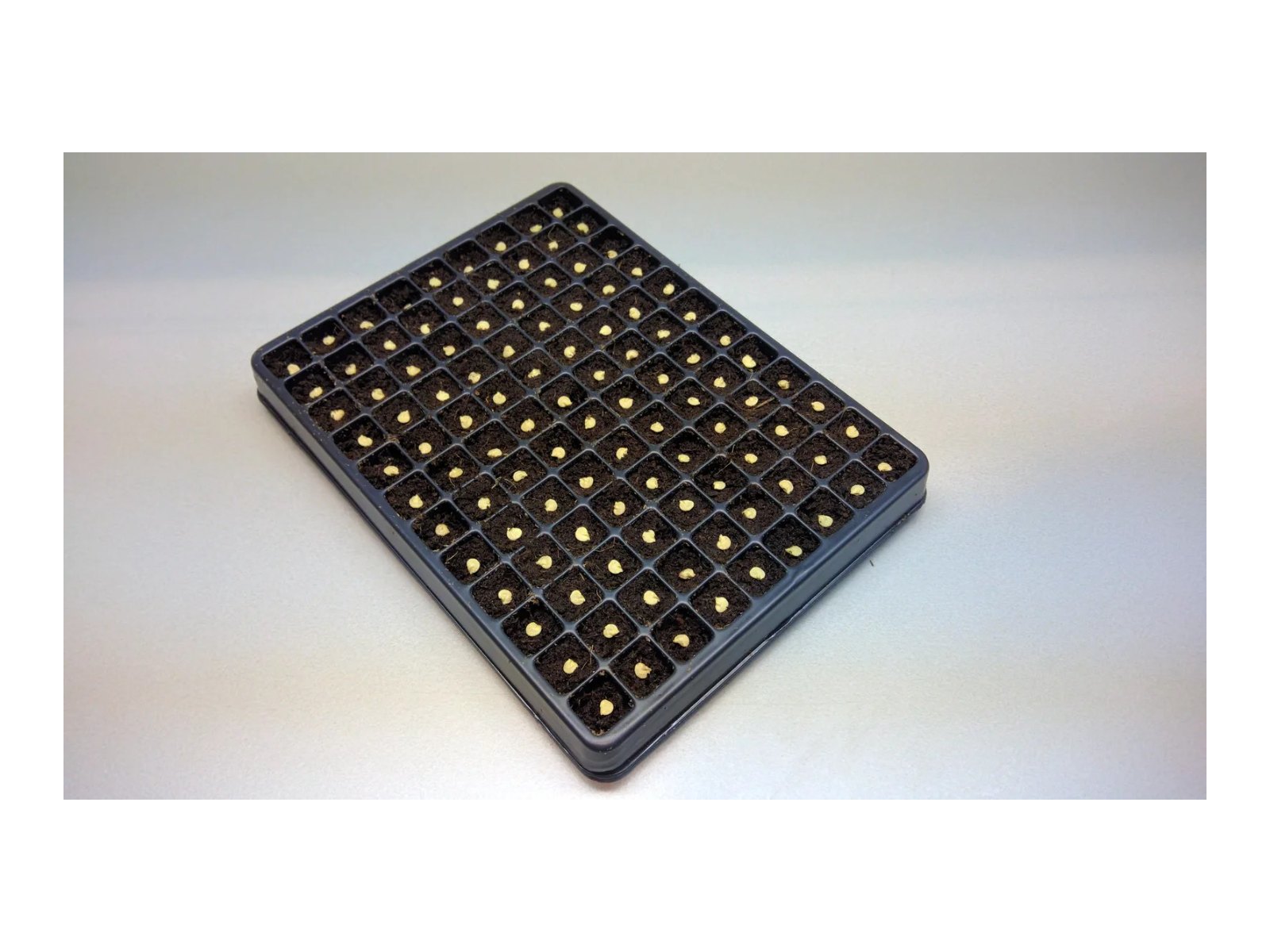
 Seeds sitting one per hole in the mesh plate, before the tap that drops them into the labware. Photo: LabTIE International B.V., own product photograph.
When the position has to stay attached to the seed
Three lines of recent work show why single seed placement is worth the trouble.
The first is non destructive genotyping. Li and colleagues describe a microneedle based method that extracts DNA from a seed without destroying it, so the sampled seed can still be sown (Li M, Dey Poonam A, Cui Q, Hsieh T, Jagadeesan S, Xu J, Bruce WB, Vogel JT, Sessions A, Cabrera A, Saville AC, Ristaino JB, Paul R, Wei Q, 2025, Plant Biotechnology Journal 23(6), 2317 to 2329, doi.org/10.1111/pbi.70055). The whole value of that method depends on the seed keeping its identity from sampling through to sowing. That only works if the seed had a known position from the start.
The second is seed health testing. Bugingo and colleagues review molecular diagnostics, imaging and machine learning in seed health labs, and put a lot of weight on chain of custody under ISO/IEC 17025: barcoding, environmental monitoring and standardised wash protocols before molecular testing. They also discuss pooling strategies, which trade cost against the risk of diluting a rare positive below the detection limit (Bugingo C, Raju TJ, Moparthi S, Singh J, Shivanna HM, Karim S, Turatsinze AN, 2026, Seeds 5(1), 15, doi.org/10.3390/seeds5010015). Pooling decisions rest on knowing exactly how many seeds went into each pool and where they came from. A tray loaded one seed per position gives you that by construction.
The third is scale. Ghamkhar and Rousseau write that genebank collections often hold thousands of accessions per species, and that traditional seed phenotyping methods such as 100 seed weight, germination tests and tetrazolium staining are labour intensive and inadequate for collections of that size, taking hours of work to reach a phenotyping goal (Ghamkhar K, Rousseau D, 2026, Frontiers in Plant Science, doi.org/10.3389/fpls.2025.1729121). Their answer is sensor based phenomics. Whichever sensor you point at the seeds, the seeds still have to be laid out first, one per position, in a known order.
Which one fits your bench
A seed counter is the right tool when the number itself is the deliverable. Packet filling, seed lot inventory, thousand grain weight work and quality control on incoming lots all end with a count, and a counting machine or a camera setup does that job well.
A dispenser is the right tool when the seed has to end up somewhere specific. If your next step is a germination tray, a microtiter or deepwell plate, a petri dish or a rack of extraction tubes, what you need is one seed per position rather than a total. In practice many labs need both, and they are not competing purchases. The counter tells you what you have. The dispenser puts it where the assay needs it.
Format is the practical question after that. Germination work on blot paper usually points to the 100-well tray seed dispenser, while single seed DNA prep in 1.5 and 2 mL tubes points to the 48 tube seed dispenser. Plate based screening stays with the 96-well format. If you already know your labware and your seed size, that narrows the choice quickly. If you are also weighing manual against automated handling, we wrote about that trade off separately in manual versus automated seed dispensers.
One caveat worth stating plainly. A dispenser does not count for you, and it does not check whether a seed is viable. It places seeds. If your bottleneck is counting rather than placing, a dispenser will not solve it, and the research above suggests an image based counter is a reasonable place to look instead.
Sources
- Zu Q, Liu T, Zhu W, Pan Y, Wang J, Song X, Yu J, Dang S, Yu X, Zhang Z (2025). Automated seed counting using image processing and deep learning. Frontiers in Plant Science 16. https://doi.org/10.3389/fpls.2025.1659781
- Ghamkhar K, Rousseau D (2026). Leveraging sensor technologies for seed phenotyping by genebanks. Frontiers in Plant Science. https://doi.org/10.3389/fpls.2025.1729121
- Bugingo C, Raju TJ, Moparthi S, Singh J, Shivanna HM, Karim S, Turatsinze AN (2026). Advances in Seed Health Testing: Integrating Molecular Diagnostics, Imaging, and AI for Enhanced Quality Assurance. Seeds 5(1), 15. https://doi.org/10.3390/seeds5010015
- Li M, Dey Poonam A, Cui Q, Hsieh T, Jagadeesan S, Xu J, Bruce WB, Vogel JT, Sessions A, Cabrera A, Saville AC, Ristaino JB, Paul R, Wei Q (2025). Non-destructive seed genotyping via microneedle-based DNA extraction. Plant Biotechnology Journal 23(6), 2317 to 2329. https://doi.org/10.1111/pbi.70055
Written by LabTIE International B.V., which builds manual seed, bead and powder dispensers for laboratories. Questions about a format or a seed type are welcome through our product overview.


 Topics
 Species