Australia
October 30, 2012
Higher yields, less risk of severe yield loss from diseases such as crown rot, the three rusts, and the pest root lesion nematode, are the main reasons North West NSW farmers Bill and son Andrew Yates are growing or intend to grow some new recently released wheat varieties.
However Bill and Andrew Yates, of “Delvin” Garah, stress that improved varieties is just one part of maximising their cropping profit.
Well planned rotations involving pulses, canola, and grain sorghum, which aim to reduce risk from diseases like crown rot and pests like root lesion nematode, are equally important to the Yates. Important also is high standard fallow efficiency and zero till stubble retention whenever it can be achieved.
Sowing early within a given variety’s optimum sowing window is also regarded by them as important. Frost is always a risk but they believe yield loss from late sowing is a greater threat.
Sunguard and Livingston, relatively new AGT wheat varieties, are currently making a big impression on the Yates farming program. They also plan to assess and likely incorporate the new APH variety Suntop and the first northern release of a high performing “two-gene” imidazolinone (Clearfield system) tolerant variety Elmore CL Plus.
Root lesion nematode Pratylenchus thornei (Pt)
Bill and Andrew Yates are especially mindful of protecting their wheat crops, as far as possible, from the often devastating root lesion nematode Pratylenchus thornei (Pt).
An extensive NSW DPI study that surveyed 248 random cropping paddocks across central and northern NSW, from Wellington to the Qld border, found that Pt was present in 70 percent of paddocks. Most significantly paddocks in areas like Moree and Narrabri almost always contained Pt, and mainly at yield damaging levels (above 5000 per kg). Other surveys have also found widespread Pt infestation at damaging levels across the Qld wheat belt.
Research by groups such as NSW DPI, Qld DAAF, and the GRDC funded group, Northern Grower Alliance (NGA), has shown that Pt can often reduce yield of bread wheat by over 50 percent and chickpeas by 20-30 percent. Measures to reduce the impact of Pt on these crops are a high priority for both farmers and researchers.
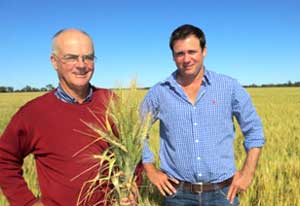
Bill and Andrew Yates “Delvin” Garah checking their Sunguard wheat that yielded above 4 t/ha despite a dry late winter spring. In North West NSW and Qld root lesion nematodes (Pt) are a common and yield devastating problem. Sunguard has tolerance equal to the best available in Australia bread wheats.
In a NSW DPI trial at Mungindi, where Pt levels were typically high (15,000/kg soil) a tolerant to moderately tolerant (T-MT) durum variety yielded 3.0 t/ha. In contrast an intolerant to very intolerant (I-VI) bread wheat variety yielded 1.0 t/ha, an estimated loss, because of Pt, of 2.0 t/ha.
Bill and Andrew Yates rate choosing varieties on their level of tolerance and resistance to Pt as one of their highest priorities. The wheat varieties Sunguard and Suntop rate highly among Australian wheats for Pt tolerance.
It should be noted that there is a second root lesion nematode species, P neglectus (Pn), that is common in many wheat growing areas, especially central and southern NSW, but also sometimes in northern NSW and Qld. It also is capable of causing significant yield loss. Bill Yates stressed the importance of knowing which nematode species is on individual farms and the level of infestation present. This could be achieved by appropriate soil testing. Different crops and different varieties within crops differ in the level of resistance and/or tolerance to each of the nematode species. In the Yates’s case Pt is their only nematode problem.
Crown rot
Crown rot has for decades been regarded as the main disease threat to wheat production in central and northern NSW and Qld. However recent research by NSW DPI, NGA and DAAF, suggests that Pt is likely to cause overall more yield loss than crown rot.
That is not to underestimate the importance of crown rot but to put it into perspective. Researchers, like NGA CEO Richard Daniel, stress that growers should first assess paddocks for disease and pest risk, second, if Pt is likely to be an issue, choose varieties with the best Pt tolerance, and thirdly assess varieties for crown rot tolerance.
Currently the best way to minimise the impact of crown rot is to use appropriate rotations. Wheat varieties with the best levels of crown rot tolerance will still suffer major yield loss if the disease is not managed to moderate levels through rotations.
In contrast if Pt is likely to be the major issue (often crown rot and Pt are present together in potentially damaging levels), appropriate variety selection can offer far greater levels of protection.
Rotations and crop management
Andrew Yates notes that research is increasingly documenting which crops and varieties are most resistant and tolerant to Pt. Fortunately for them grain sorghum is resistant and growing it as part of their rotation helps keep Pt numbers within reasonable levels. However periodic floods moving over their land can carry in Pt and undo the benefits of sound rotation.
The Yates are also experimenting with canola and have grown commercial areas this season. Canola has good Pt resistance and therefore should lower levels of Pt, and because of relatively earlier sowing and harvest, canola could fit well into their rotation. Canola’s role on “Delvin” will ultimately be determined by price and yield outcomes this season.
Chickpeas (HatTrick), a very important crop on “Delvin”, unfortunately are susceptible to Pt and will therefore increase Pt levels in paddocks. While still a few years off Bill Yates is especially hopeful of chickpea varieties being released with greatly improved resistance, a goal of the GRDC funded Australian chickpea breeding program. Tamworth based NSW DPI national chickpea breeder Kristy Hobson has genetic material in her program with good resistance to Pt.
Barley is also grown on "Delvin” as part of the rotation. While barley varieties are variable in susceptibility to Pt, overall they are useful for keeping numbers down and most are rated MS-MR (moderately susceptible moderately resistant). Unfortunately current faba bean varieties are susceptible to Pt and have to be used carefully in the rotation.
Wheat on wheat is not a preferred option on “Delvin”. If wheat on wheat is ever used a management program to guard against YLS (e.g. a strategic fungicide program) losses is applied and a variety like Sunguard is used in order to reduce risk of losses from crown rot and Pt.
Rusts
Stem, leaf and stripe rust are all important diseases to the Yates and where possible they choose varieties with at least adequate resistance ratings to all three. Bill Yates especially reminds younger growers that wheat growing in northern NSW and Qld was always a very risky business until plant breeders developed, initially stem rust resistant, and then leaf rust resistant varieties.
Stripe rust, a later arrival in Australia, has also challenged plant breeders but fortunately more varieties are now being released with durable stripe rust resistance.
One can aim to guard against rusts with fungicides but especially for stem and leaf rust this can prove costly as well as difficult, involving multiple treatments and exact timing. As Bill Yates stresses, “it is best to strengthen ones ability to deter these diseases by using resistant varieties wherever possible”.
Yield quality and agronomic type
Andrew and Bill Yates place high credibility on GRDC funded NVT variety trials for assessing yield ability, especially when choosing new varieties. When new varieties like Livingston, Sunguard and Suntop are released with several years of NVT assessment, any claims of yield improvement can be rigorously assessed.
While the Yates generally aim to use APH quality varieties they are happy to plant a good portion of their crop to AH quality varieties if the varieties available meet high yield, good agronomic type, and good disease and nematode resistance standards.
Their nitrogen management is also in tune with an ever increasing need to match higher yield ability with relative soil nitrogen availability to maintain high grain protein.
Because of the inherent variability of time of sowing opportunities in the north, Andrew Yates strongly favours sowing at the early end of a varieties optimum sowing window to maximise yield potential. Bill Yates is involved as an “Australian Climate Champion” and believes as average temperatures rise the window for growing a cool season crop shortens. He believes shorter maturing crops and varieties will increasingly be required and the penalty for late sowing will become more severe. This year, for example, Mungindi recorded the first 30C day on the 23rd of August.
The Yates choose a range of maturity types in their variety selection in order to help manage risk. For the Yates, varieties with sound agronomics need to also include a multitude of features such as seedling vigour, straw strength, ability to hold grain, and harvestability.
Future variety requirements.
Andrew Yates lists improved variety tolerance to yellow leaf spot (YLS) as one of their biggest needs.
Currently a few varieties have good YLS tolerance but these varieties mostly have other problems such as Pt susceptibility and/or intolerance, low yield and susceptibility to some or all of the three rusts.
Many of today’s varieties do have improved tolerance to YLS compared to the mostly very susceptible (VS) ones that predominated in the last major YLS years of the late 1980s.
Wet weather at harvest is also a common concern to growers like the Yates. Varieties with significantly higher levels of pre-harvest sprouting tolerance than even Ellison and Sunelg are in the current wheat breeding pipelines.
Greater wheat coleoptile length is another attribute sought by the Yates to improve their ability to establish their crops on time. This is also now an important wheat breeding priority.
Clearfield® Wheat Varieties to assist in managing difficult weeds
The Yates will be trialling Elmore CL Plus which is the first high performing “two-gene” imidazolinone (Clearfield system) tolerant variety suitable for central NSW, northern NSW, and Qld wheat growers. “Two-gene” varieties have improved crop safety to imidazolinone herbicides, such as Intervix®. This improved level of tolerance is also important in managing carryover of some herbicides that may not have sufficiently broken down in the previous crop or fallow.
Properly rotated with other weed control choices (including herbicides from other chemical groups as well as various agronomic practices) the Clearfield option can provide new cost effective ways to control a number of difficult to control weeds.
Elmore CL Plus is an early to mid maturing variety similar in plant type to Janz. In NSW and Qld NVTs it has been very competitive for yield and offers solid levels of resistance to the three rusts.
Elmore CL Plus has an AH quality classification in NSW and Qld.
Other wheat varieties
Andrew and Bill Yates also grow EGA Gregory, a high yielding APH quality (AH in central and southern NSW), good rust resistant variety. EGA Gregory is also rated MT to Pt. It is an earlier sowing variety and tends to have a good fit for the start of the “Delvin” wheat cropping program.
Seed Availability
NSW/Queensland AGT Territory Manager, Kerrie Gleeson, reports that seed of Sunguard, Suntop and Elmore CL Plus will be available in good supply in autumn of 2013. Seed will be available to growers through an AGT Affiliate or their local retailer.
.For further information: www.ausgraintech.com; phone +61 2 6881 6210


 Topics
 Species