Australia
March 27, 2014
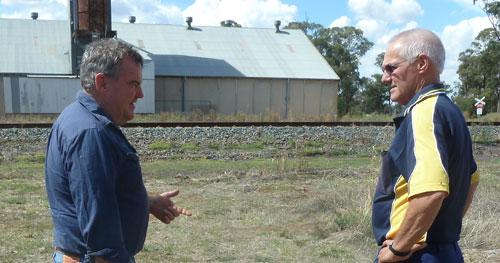
Riverina grower Michael Marchant, Morangarell, chats to Jim Lamb, Australian Grain Technologies, about the promising performance of the new, shorter season Suntop wheat variety on his property last year despite the tight finish to the season.
VARIABLE seasons in recent years have highlighted the value of spreading farming risk and it was a move that paid off last year for Riverina grower Michael Marchant.
Michael operates a cropping and sheep enterprise on his 930-hectare ‘Morangarell’ property near the namesake township, located 45 kilometres north of Temora, and last year decided to add the new, shorter season Suntop wheat variety to the longer season EGA Gregory variety grown on the farm.
“Since the floods, we have had shorter springs and so we went with Suntop as a shorter season variety to help split our options,’’ said Michael, who previously worked with NSW Department of Primary Industries’ wheat breeding unit at Wagga Wagga and evaluation unit at Temora and was an agronomist through the region.
“It has enabled us to grow a spread of wheats with different maturities to spread our risk – also to help manage frost, which can be an issue through this area.
“We can spread our sowing window by sowing Wedgetail grazing wheat, then canola, then Gregory and then Suntop.’’
Bred and selected by Australian Grain Technologies’ PBI Narrabri-based wheat breeding team, Suntop is an Australian Prime Hard (APH) classified variety and is widely adapted throughout NSW and Queensland.
Prior to its commercial release, it demonstrated superior grain yield to other APH varieties, including EGA Gregory and Spitfire. It performed extremely well in all testing, including GRDC-funded National Variety Trials (NVT).
Michael grew Suntop over 100ha last year at ‘Morangarell’, which comprises heavy, grey cracking clays through to self-mulching soils.
Following knockdown weed control, it was sown into canola stubble at 50 kilograms/ha with 70kg/ha of DAP fertiliser and 60kg/ha of urea banded below the seed. Nitrogen nutrition was later topped-up with a liquid fertiliser application at 30 litres/ha.
Michael was impressed with Suntop’s final yield of 3.7 tonnes/ha and grain protein of 10.5-11 per cent, especially considering the property received only about half of its normal annual rainfall last year.
“It was sown into good conditions and it was a good start to the season during June and July, but it then shut-off at the end of August and into September.’’
“It was very quick out of the ground. We sowed the Gregory at the end of April and the Suntop in the second week of May and they finished almost at the same time. And it never pinched-off – screenings were very low.
“It’s a beautiful wheat to strip. It’s a very easy threshing wheat. We had some wind, but it didn’t thresh out in the wind storms.’’
The Suntop variety also has an excellent disease profile, including good levels of resistance to all current field strains of leaf, stem and stripe rust, which has been an important consideration influencing variety selection by NSW and QLD growers in recent years.
“It has a very good disease package. We’ve had some disasters in the past with rust and we don’t need the headache.’’
Michael, who is also manager / agronomist at the AgnVet store at Bribbaree and is supported on the property by his daughter, Lauren, also an agronomist, plans to sow Suntop over 120ha in the coming season and he expects it will become one of the most dominant wheat varieties grown in the area.
“It’s a high yielding wheat and we need to build a package around it, including monitoring and getting the nutrition right to maximise its performance and for protein.’’
Suntop also has good tolerance to acid soils, which will be appreciated by growers particularly in southern NSW, and root lesion nematode (RLN), which will benefit producers in the north of the State. Recent research has shown that varieties with similar RLN tolerance to Suntop can yield up to 50 per cent higher than susceptible varieties when grown in infected conditions.
Suntop has moderate tolerance to black point, a physiological disorder often appearing during wet finishing conditions that can result in downgrading. Varieties with moderate tolerance to black point, like Suntop, are generally far less susceptible to quality downgrading compared with susceptible varieties.
Seed of Suntop for the 2014 season is available through AGT Affiliates and local seed resellers. For further information, growers can also visit www.ausgraintech.com


 Topics
 Species