St. Louis, Missouri, USA
May 26, 2026
As severe storms threaten the US Corn Belt with greater frequency, new research points to a practical solution already in development
Wind damage to corn has increased in nearly nine out of ten maize-producing counties in the United States in recent years. As a changing climate drives more frequent and intense storms, the threat to one of the world's most important food crops is expected to grow. A new study co-authored by a Donald Danforth Plant Science Center scientist offers a promising path forward: maize plants engineered to be shorter are far better at surviving the high-speed straight-line winds that flatten conventional corn fields.
The research, published in Crop Science, found that short-stature maize hybrids, which stand roughly 25 to 30 percent shorter than conventional corn, experienced wind damage at less than half the rate of tall hybrids across three growing seasons and hundreds of locations throughout the US Corn Belt. At sites where storms struck hardest, short-stature plants continued to produce harvestable grain even where tall hybrid plots were so severely damaged they could not be harvested at all.
"Wind damage is a growing threat to corn production, and it's only expected to worsen as climate patterns shift," said Erin Sparks, PhD, Danforth Center principal investigator and associate professor and Bond Life Sciences Center principal investigator at the University of Missouri–Columbia. She is also the founder of Izbe Innovations. “This study gives us a much clearer picture of how plant architecture, specifically, reducing stature, can serve as a real and scalable tool for climate resilience.”
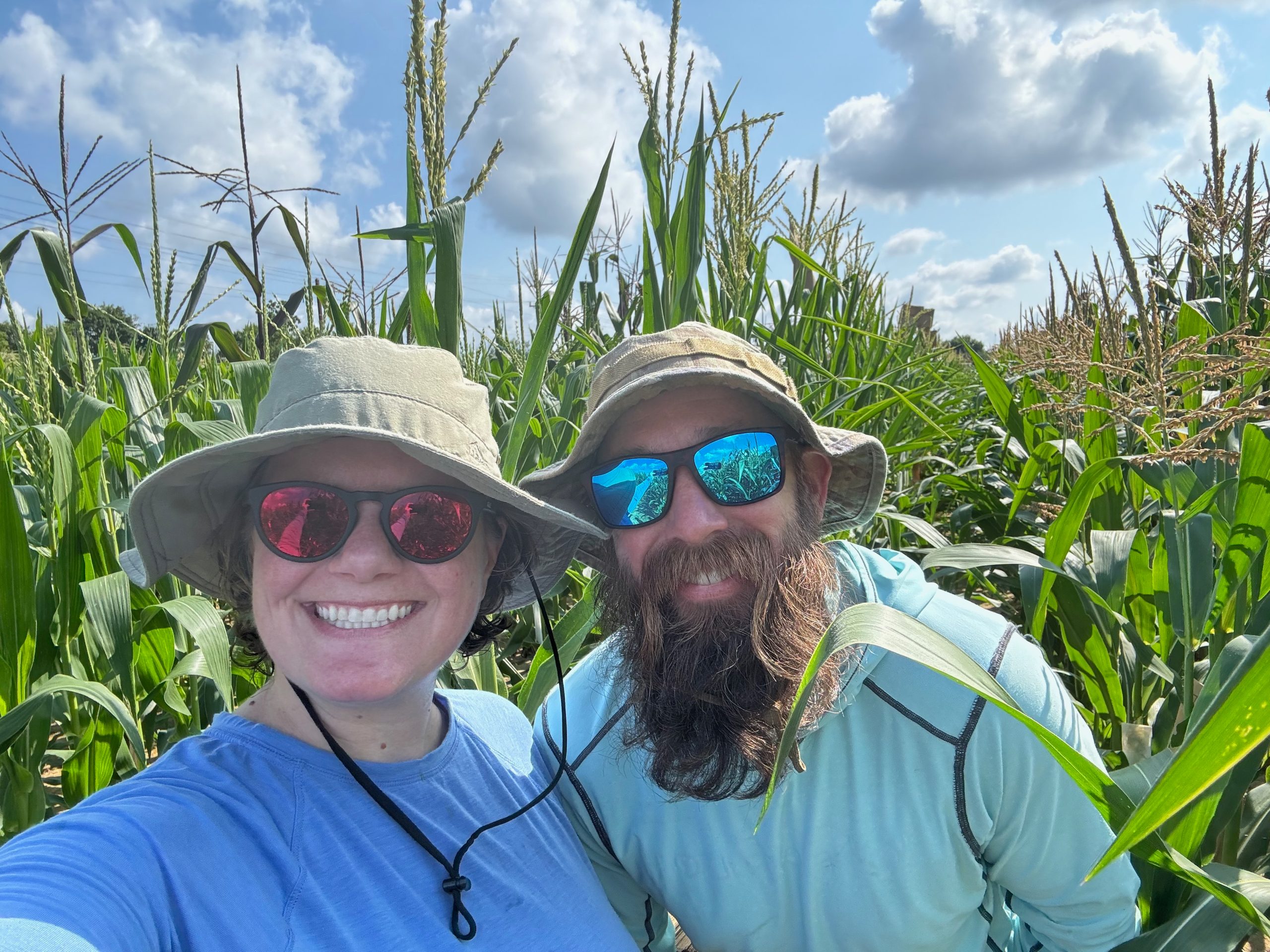 Dr. Erin Sparks and Dr. Jon Reneau, co-authors on the study, stand together in one of their experimental corn fields.
The findings draw on one of the largest datasets ever assembled on corn “standability,” spanning 444 field trial locations and three types of wind damage: root lodging, in which stalks fall over without breaking due to root failure; stalk lodging, in which the stalk buckles or breaks below the ear; and greensnap, in which rapidly growing stalks snap cleanly at a node during early-season winds.
The research also shed new light on why short-stature plants resist wind damage. Using a specialized device to measure root system stiffness, the team found that two of three tested short-stature hybrid lines had root systems that were approximately 30% more flexible than their taller counterparts. That combination—shorter stalk, more flexible roots—appears to work together to reduce the physical forces that cause plants to topple. (See a video of the “SMURF” - Sorghum and Maize Under Rotational Force - device at work here.)
The study reflects a productive partnership between the Danforth Center and Bayer Crop Science, whose North American field-testing organization collected the large-scale dataset that made the research possible. Dr. Sparks, who also holds a faculty appointment in the College of Agriculture, Food and Natural Resources at the University of Missouri–Columbia, contributed to the study's design, data collection, and analysis, an example of the cross-sector and cross-institutional collaboration the Danforth Center pursues to move plant science from the laboratory toward real-world impact.
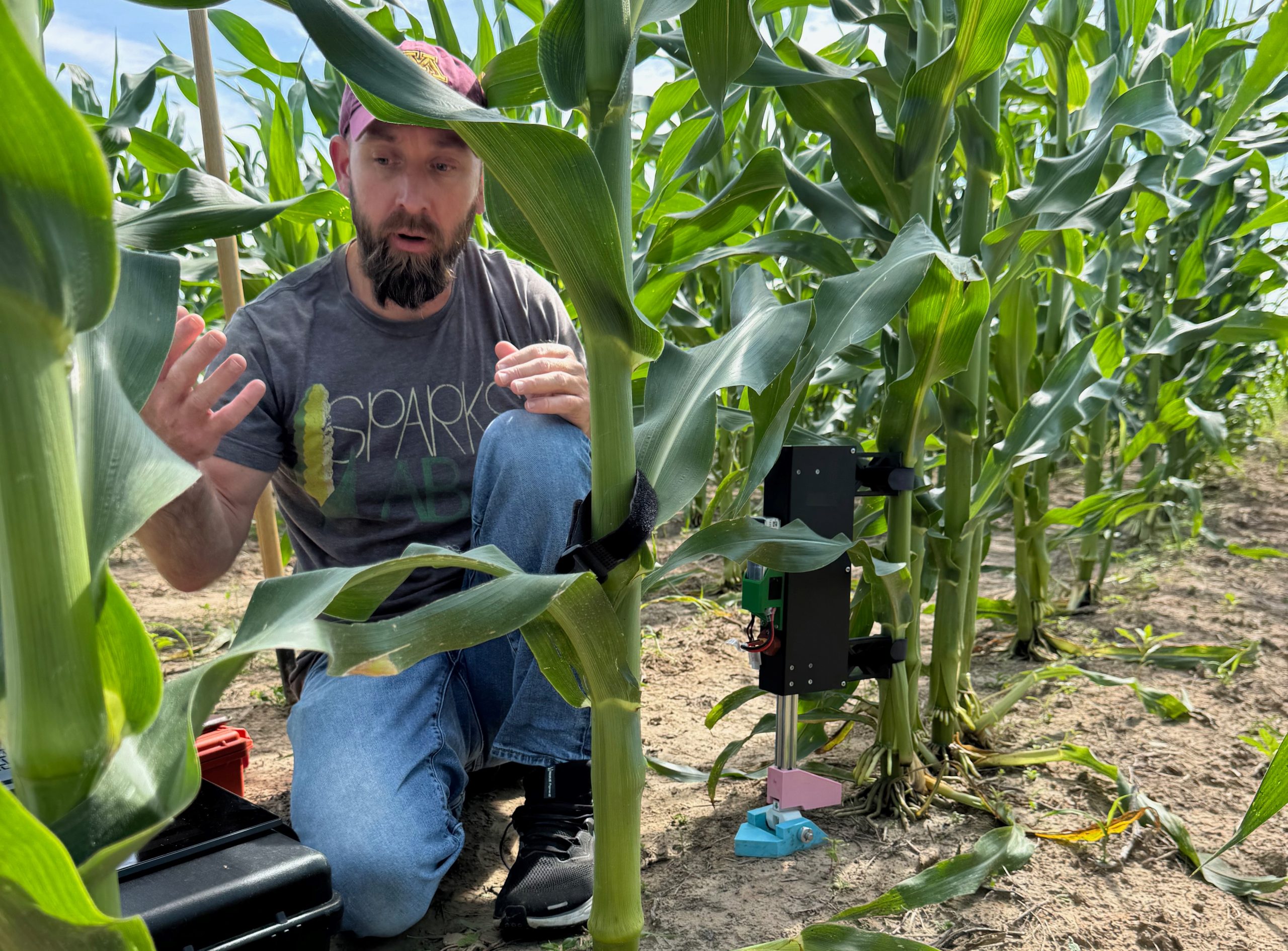 Jon Reneau observes the resilience and flexibility of corn that is undergoing testing via the SMURF (Sorghum and Maize Under Rotational Force device).
“The collaboration between the Danforth Center and the University of Missouri is one of the most important engines we have for translating plant science into real-world solutions," said Giles Oldroyd, Danforth Center president. “Dr. Sparks's work with Bayer Crop Science is a powerful example of what becomes possible when world-class research institutions and industry partners work toward a shared goal—practical tools that help farmers adapt to more unpredictable weather."
Short-stature maize builds on principles proven during the Green Revolution, when semi-dwarf wheat and rice varieties transformed global food production by dramatically reducing crop losses to lodging. Applying that same logic to corn, the cereal crop that has seen the greatest production growth over the past six decades, could provide meaningful protection to growers at a time when the weather is becoming harder to predict and the stakes for global food security are rising.
Citation
Byron Evers, Frank G. Dohleman, Kevin R. Kosola, Ty J. Barten, Jiarui Li, Jonathan W. Reneau, Erin E. Sparks, Magen Eller, Lillian Brzostowski, Timothy Wertin, Connie Davis, Mike Hall, Lyle Ralston, and Alex Renaud. "Short-stature maize hybrids reduce the number of locations with wind damage by 64% in the US Midwest." Crop Science, 66, e70281 (2026). https://doi.org/10.1002/csc2.70281


 Species